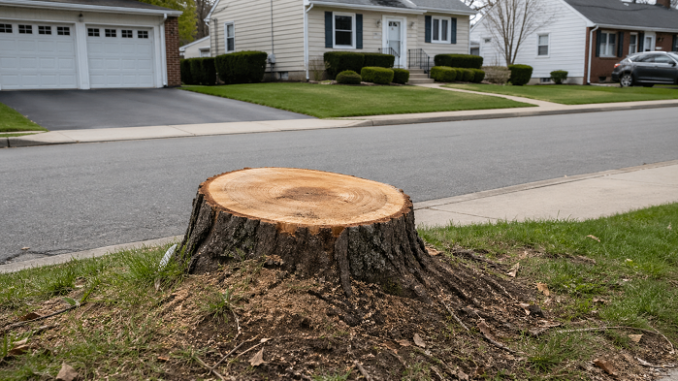
Peterborough has always sold itself as a city with one foot in town and the other in the woods. The river, the trails, the parks, the old neighbourhood maples throwing shade over sidewalks that were never designed for the kind of heat we now get.
It is part of the pitch: come here, breathe a little, slow down, pretend for five minutes that we have not paved paradise one committee report at a time.
But the remaining tree stands in Peterborough are becoming something more than scenery. They are now the front line in the city’s favourite modern argument: how much green do we keep, and how much do we sacrifice in the name of housing, growth, “intensification,” and the sacred municipal religion of development?
According to the City’s own urban forest planning material, Peterborough’s tree canopy sits at about 29 percent, with a long-term target of 35 percent by 2051. That sounds noble enough, in the way all municipal targets sound noble when safely parked decades down the road. By 2051, half the people approving today’s decisions will be retired, relocated, or standing proudly beside a plaque explaining why the forest used to be here.
The official language is beautiful, of course. According to the City, trees support community health, reduce heat buildup, absorb stormwater, improve air quality, provide habitat, and generally perform all the essential civic duties that do not require a consultant, a ribbon-cutting, or a naming-rights sponsor. On paper, Peterborough recognizes the urban forest as “green infrastructure,” which is what nature gets called once governments realize it has been working for free.
According to the City, roughly 80 percent of Peterborough’s urban forest is privately owned. That means much of the canopy depends not just on parks, trails, and public land, but on backyards, old lots, development sites, fence lines, and those stubborn leftover stands of trees that somehow survived the first few waves of progress. In other words, the future of Peterborough’s tree canopy rests partly in the hands of property owners, developers, and whatever mood City Hall happens to be in when the next plan lands on the table.
That is where the tension lives.
Peterborough needs housing. Nobody serious denies that. The city is growing, pressure is coming from every direction, and the old model of endless sprawl is expensive, inefficient, and politically dressed up as “choice.” The Official Plan is supposed to guide where housing, parks, industry, schools, roads, sewers, and natural areas go. It is the city’s grand map of the future — or at least the document everyone points to when they want their preferred version of the future to sound official.
The problem is that master plans can start to sound like magic tricks. A park can be “enhanced” while trees disappear. A natural area can be “protected” while development creeps to its edge. A subdivision can arrive with a Tree Preservation Plan, an Arborist’s Report, compensation language, fencing requirements, and enough paperwork to make a stump feel represented.
According to the City’s park development standards, development lands can require tree preservation plans and arborist reports before work proceeds. There are also rules around protection measures and compensation when trees are removed or damaged. Which sounds reassuring, until you remember that municipal process has a remarkable talent for turning “no” into “yes, but with conditions.”
And compensation is not a forest.
A sapling is not a mature canopy. A tree planted in a subdivision boulevard is not the same thing as an older stand cooling an entire block, holding soil, sheltering birds, and giving a neighbourhood some memory. It may be necessary. It may be better than nothing. But it is not an even trade, no matter how neatly it fits into a staff report.
That is the uncomfortable part. Municipal language often treats nature like an accounting problem. Lose trees here, plant trees there. Remove canopy now, replace canopy later. Take down a living system and promise a future version in a spreadsheet. It is the same logic that says a park is still a park if enough of it remains green on a diagram.
To be fair, the City is doing some real planting. According to recent City announcements, Peterborough received $1.62 million through the Federation of Canadian Municipalities’ Growing Canada’s Community Canopies initiative to plant up to 4,000 trees across the city. Beavermead Park, for example, is getting new native trees after damage from the March 2025 ice storm, with the City saying the work supports canopy goals and improves the park’s natural and recreational value.
That is good. Necessary, even. The derecho in 2022, emerald ash borer, and the 2025 ice storm all battered the canopy. The city is not wrong to replant. But the larger question remains: are we planting because we believe in the urban forest, or because we are trying to catch up with what we keep losing?
Because there is a difference.
Peterborough’s remaining tree stands should not be treated as inconvenient green clutter waiting for a better use. They are part of the infrastructure of a livable city. They cool neighbourhoods. They absorb water. They soften noise. They make walking bearable. They are also one of the few civic assets that get more valuable by simply being left alone, which may be why they make certain people so nervous.
And yet, in a development-first climate, every untouched patch starts to look temporary. A stand of trees becomes “underutilized land.” A wooded edge becomes “future opportunity.” A park becomes a site to be “activated,” which too often means more asphalt, more courts, more parking, more lighting, more fencing, and fewer places where a person can just sit under a tree without being organized into a recreational strategy.
This is how cities slowly lose themselves. Not in one dramatic act, but one reasonable exception at a time. One approved plan. One minor adjustment. One “balanced approach.” One development application promising sustainability while quietly removing the thing that was already sustainable before anyone brought in a planner to explain it.
The real test for Peterborough is not whether it can write another plan saying trees matter. It has done that. The test is whether those plans have teeth when development arrives with lawyers, consultants, renderings, and the usual promise that everything will be better once the chainsaws stop.
Because that is when the poetry ends. That is when “green infrastructure” meets “economic development.” That is when the canopy target becomes a nice sentence in a document while the actual canopy gets fed into a chipper behind a temporary construction fence.
If the city is serious about its canopy target, then mature tree stands need to be treated as assets, not obstacles. Development should have to work around them wherever possible, not simply explain why they had to go. Parks should be improved without being stripped of the very thing that makes them parks. And when the City talks about intensification, it should be honest about the trade-offs instead of hiding behind soft words like enhancement, renewal, and balance.
Peterborough can grow. It probably has to. But growth that eats the shade, flattens the last natural corners, and then holds a press conference beside a newly planted sapling is not vision. It is damage control with a shovel.
The trees left standing are not sentimental leftovers from an older Peterborough. They are part of whether the next Peterborough is actually livable — or just hotter, harder, denser, and very well planned.