Peterborough’s bike-lane argument usually gets framed like some culture-war yard sale: drivers on one side, cyclists on the other, everyone acting as if a painted line on asphalt is either the dawn of civilization or the collapse of it. But the real question is simpler than that. Is the trade-off worth it? Is the money spent on bicycle paths and active transportation actually buying something useful back?
According to the City of Peterborough’s own budget material, trails and cycling network implementation now ranks among the city’s 20 largest capital projects, with $1.82 million slated for 2026 and a total project cost of $15.01 million. According to the same city budget pages, that spending sits alongside projects like the Crawford Trail Extension, city-wide trail rehabilitation, and sidewalk installations. So yes, there is real money going into this. Nobody is building bike infrastructure out of spare change found under the cushions at City Hall.
And in a city where every tax dollar already has 14 people fighting over it, that matters. Roads need work. Sidewalks need work. Housing pressure is real. Aging infrastructure is everywhere. So the skepticism is understandable. If Peterborough is spending cash on bike lanes and trails, people are entitled to ask what they are getting for it besides a few more signs and some moral superiority from the active-transportation crowd.
According to the City’s climate and transportation material, Peterborough now has 76 kilometres of dedicated bike lanes and trails. According to the City’s walking and cycling information, it also maintains 42 kilometres of paved trails through the winter. The City also says one in ten people in Peterborough walk or bike to work. Depending on which document is doing the counting, the broader network pushes past 80 kilometres when side paths and multi-use trails are included. So this is no longer some symbolic gesture for fair-weather cyclists in expensive helmets. Peterborough has built an actual network, and it is growing.
The harder question is whether that network earns its keep.
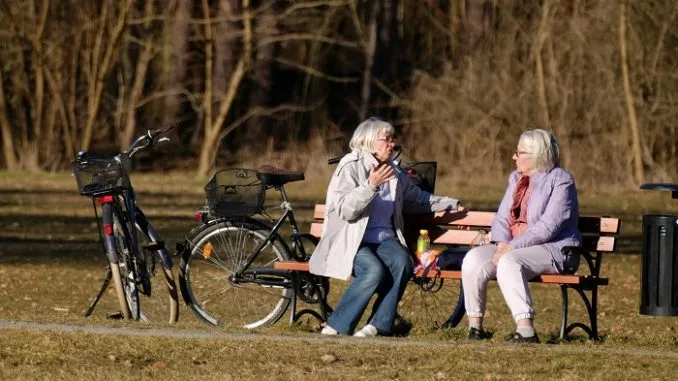
That is where the health argument starts to matter. According to federal and Statistics Canada population profiles, Peterborough is an older community, with roughly a quarter of its population at 65 or older. That changes the conversation. In a younger city, bike infrastructure can be sold as lifestyle or climate policy. In Peterborough, it also has to be understood as aging-community infrastructure. According to Age-friendly Peterborough’s community action plan, one of the city’s major goals is helping older adults stay mobile through accessible transportation and safe, year-round active routes.
That is not decorative policy language. That is the city quietly admitting that mobility is a health issue.
If older residents can safely walk, cycle, or use connected trails for short trips, exercise, and everyday movement, that helps support independence, physical activity, and social connection. And in an older community, those things are not just nice ideas. They are part of the difference between people staying active and engaged, or becoming more isolated, more sedentary, and more dependent on other parts of the system to pick up the slack.
According to national public health research, adults who use active transportation are more likely to meet physical-activity recommendations than those who do not. According to Canadian research on bicycle-infrastructure investments in mid-sized cities, the health-related benefits can outweigh the cost of the infrastructure itself. That does not mean Peterborough automatically gets the same payoff on every metre of trail or every strip of painted lane. Bad planning is still bad planning. A disconnected route that goes nowhere useful is still a disconnected route that goes nowhere useful. But the larger point stands: the cost of bike infrastructure should not be measured only against the construction bill. It should also be measured against what it may save or improve over time.
Peterborough’s own asset-management material makes the other side of the case plain enough. According to the City, the average annual lifecycle cost of the active transportation network is about $4.2 million, and projected funding is not sufficient to meet growth demands without intervention. Which is municipal shorthand for this: once you build infrastructure, you own the headache. It needs maintenance. It needs rehabilitation. It needs to be cleared, repaired, resurfaced, connected, and paid for long after the ribbon-cutting crowd has wandered off for sandwiches.
So no, this is not free. And no, there is no magic bike-lane fairy sprinkling wellness savings all over the tax base.
But there is another part of the equation, and it is one Peterborough would be foolish to ignore. According to the City’s trail information, Peterborough is part of the Trans Canada Trail system, with a 10-kilometre section running east-west through the city and connecting toward Hastings in one direction and Lindsay in the other. According to the City, the local trail system also links into hundreds of kilometres of cycling routes in neighbouring communities. The Rotary Greenway Trail, for instance, helps connect the city north toward Trent and on to Lakefield. So this is not just about getting from one subdivision to another without using a car. It is about Peterborough functioning as part of a much larger regional route.
That matters economically, recreationally, and culturally. A connected trail system is not just a local amenity. It is a piece of regional infrastructure. It draws use, supports tourism, improves recreational access, and makes the city feel less like an isolated pocket and more like part of a broader corridor.
So is the trade-off worth it?
That depends on whether Peterborough builds smartly. If the city throws money at fragments, vanity routes, and disconnected gestures, then the critics will have a point. But if it builds a usable, connected, maintained network that serves commuters, older adults, recreational users, and regional trail connections, then the spending starts to look less like indulgence and more like a practical investment in how this city functions.
That is the real argument. Not whether bike lanes annoy drivers. They do. Not whether they cost money. Of course they do. The real question is whether Peterborough gets enough back in mobility, health, connectivity, and long-term public value to justify the spend.
According to the city’s own plans, according to its own demographic reality, and according to broader Canadian health research, the answer is probably yes.
The catch, as always, is that Peterborough now has to prove it knows the difference between infrastructure and symbolism.