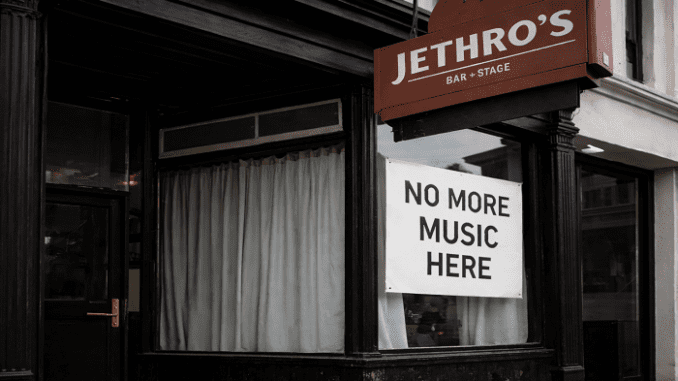
Jethro’s Bar + Stage closing is not just another downtown business shutting its doors. It is the latest reminder that Peterborough still loves live music, but has become a much harder town in which to actually make it happen.
Jethro’s was opened in April 2022 by musician Kayla Howran and her family, not as a generic bar venture, but as a deliberate attempt to create a small, intimate room for live performance. Their motivation was simple and important: Peterborough had larger venues, but it had lost too many of its smaller stages. Jethro’s was meant to help fill that gap — a cozy place where artists could showcase themselves up close, where local musicians could find a stage, and where even family-friendly matinees could have a home. It came from people who cared about music enough to build a room around it.
That matters, because Jethro’s was one of the few true music-first rooms left in Peterborough. It was the kind of place that existed for the songs, not just the sales. When there wasn’t music, there often wasn’t much point to the room. That is a very different thing from a pub that happens to let somebody plug in on a Friday night. Jethro’s gave local musicians, touring acts, and audiences a place that felt built for live performance, even on a small scale. Losing that leaves a mark.
And that is really the story of live music in Peterborough right now. The city is not short on musicians. It is short on rooms that are actually accessible to them.
Gordon Best still matters culturally, but it does not operate as a venue that actively books bands in the traditional sense. It rents the room. That still gives artists a place to present work, but it shifts the burden onto whoever is trying to make the night happen. You are not being booked into a scene. You are renting space and building the event yourself.
The same problem exists, in a different form, with Market Hall and Showplace. They are important venues, but for most local musicians they are not realistic stepping-stones. They are cost-prohibitive unless a promoter is involved, a local showcase is being assembled, or someone is willing to take a financial swing. They are not the kind of rooms where a band can gradually build a following over repeated low-stakes gigs. They are bigger, more formal, and simply out of reach for many artists trying to get a foothold.
So what is left? A patchwork.
McThirsty’s has live music and gives solo acts and smaller performers a regular place to work. Dolce Vita, Sticks and Puck N Pint (sports bars no less), Crook & Coffer have done much the same and an occasional show at The Social. The Black Horse goes further, featuring live local music nightly with no cover, which makes it one of the more consistent and accessible places in town for both musicians and audiences. The Pig’s Ear also continues to support local music on weekends, usually with a small cover charge that goes directly to the bands. These places matter. They keep music visible. They give players somewhere to go, and in a city this size that counts for a lot. But they are still hospitality businesses first. Music is part of the atmosphere, or part of the draw, rather than the sole reason the room exists. That creates a very different kind of scene than one built around dedicated listening spaces.
That is the gap Peterborough keeps circling. There is still live music here. Plenty of it. There are festivals, pub gigs, restaurant sets, summer concerts, tribute shows, songwriter nights, open mics, and the occasional locally built showcase held together by sheer stubbornness. But that is not the same thing as having a healthy grassroots circuit.
A real scene needs rooms where original acts can be rough around the edges. Rooms where the point is discovery, not just familiarity. Rooms where somebody can fail, improve, come back next month, and slowly build something. Rooms where the second set does not have to sound like the first one, and nobody is asking for more of the songs people already know from classic rock radio.
Instead, Peterborough increasingly feels like a city where live music survives in borrowed spaces. One night in a pub. One night in a restaurant. One rented room above a bar. One showcase if the right promoter pulls it together. One festival slot in summer. Music is still happening, but often without the kind of infrastructure that lets a real local scene grow roots.
That is why Jethro’s matters. It was one of those places that gave music a home instead of a timeslot. It was not just another room with a mic stand in the corner. It was part of a shrinking category in Peterborough: a place where music was the main event.
The uncomfortable truth is that Peterborough has the talent, the audience, and the musical history. What it lacks is security. Too many spaces are temporary, conditional, or financially out of reach. Too much depends on goodwill, side hustles, underpaid artists, and owners willing to carry more than the business model can really support.
So the state of live music in Peterborough is not dead. It is active, talented, and still part of the city’s identity. But it is also precarious, pieced together, and more dependent than ever on venues that accommodate music rather than exist for it. Jethro’s closing does not prove Peterborough has no music scene. It proves the scene has fewer real homes than it used to, and every time one disappears, the city is asked to pretend that patios, pubs, and rented rooms are enough.