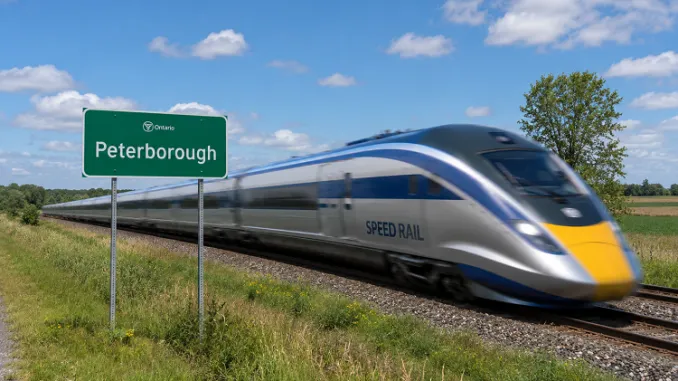
For decades, Canadians have talked about high-speed rail the way Peterborough talks about a second Costco — constantly, passionately, and with absolutely nothing happening. Meanwhile, Europe quietly built the future. You can step onto a train in Paris, sip a coffee, answer a few emails, stare moodily out a window like you’re in an arthouse film, and suddenly you’re in Brussels. Or Amsterdam. Or Lyon. Or somewhere else with impossible pastries and functioning infrastructure.
In Canada? We still treat passenger rail like a novelty ride at a heritage village.
So when the federal government unveiled the proposed Alto high-speed rail corridor — connecting Toronto, Peterborough, Ottawa, Montreal and Quebec City — the reaction in this country was almost adorable. Breathless headlines. Political chest-thumping. The kind of excitement Europeans reserve for a new vending machine. Because over there, high-speed rail isn’t futuristic. It’s Tuesday.
And yet, here comes Peterborough — a city long treated like the forgotten middle child of Ontario infrastructure — suddenly appearing on maps beside Toronto and Montreal like somebody finally remembered we exist. It’s about time. Not just for Peterborough. For Canada.
For years this country has behaved like geography is some unbeatable final boss. Too big. Too spread out. Too expensive. Meanwhile countries with mountains, ancient cities, dense populations and functioning public expectations somehow figured it out decades ago.
Japan launched the Shinkansen in 1964. France’s TGV has been blasting across the countryside since the early ’80s. Spain has more high-speed rail than almost anywhere in Europe. Even Morocco now has high-speed rail. Canada’s great achievement has been VIA Rail arriving only moderately late. So naturally, resistance has already begun forming before a single section of track exists.
Some of it is legitimate. Farmers worried about land expropriation. Small communities concerned about corridors slicing through rural properties. Taxpayers staring at an eye-watering price tag while potholes still swallow Hondas whole every spring. Fair enough.
But mixed into that are the usual Canadian gatekeepers of inertia — political cynics, anti-transit ideologues, budget hawks who somehow never blink at highway expansions, and the deeply entrenched national religion of “why bother, it’ll never happen anyway.”
There’s also the quiet resistance nobody says out loud: high-speed rail threatens existing power structures. Airlines don’t love it. Highway lobbies don’t love it. Some suburban political interests don’t love anything that shifts growth patterns away from car dependency. The moment rail becomes fast, reliable and practical, it changes how people live, commute and spend money.
And change, in Canada, often gets treated like vandalism. Peterborough knows this story better than most. This city has watched governments announce, cancel, revive and quietly bury rail promises for generations. Every few years somebody dusts off a transportation study, points at a map, says “economic corridor” three times, then disappears into a consulting contract. But Alto feels different. Bigger. More serious. More dangerous politically because expectations are now attached. Suddenly Peterborough isn’t just a stop between places. It becomes strategically located between some of the largest economic regions in the country. That changes conversations. About housing. About business. About tourism. About commuters. About whether young professionals could actually live here without feeling cut off from the rest of civilization after 9 p.m. Imagine boarding a train in Peterborough and being in downtown Toronto faster than many GTA commuters currently manage from… the GTA. That’s the part that quietly terrifies people.
Because high-speed rail doesn’t just move passengers. It rearranges gravity. Cities grow differently around it. Property values shift. Employers rethink geography. Entire regions become economically connected in ways highways never fully achieve.
It also has the potential to take an enormous number of cars off Ontario highways. If even a modest percentage of travellers between Toronto, Ottawa and Montreal shift from cars to rail, that means fewer vehicles grinding along the 401, fewer endless weekend backups, fewer airport shuttle runs, and fewer people white-knuckling snowstorms between cities because Canada collectively decided driving six hours was somehow normal.
And tourism changes too. Europe figured this out years ago. Fast rail doesn’t just connect major cities — it feeds smaller ones along the route. People suddenly take spontaneous weekend trips. Concertgoers travel farther. Conferences spread out. Restaurants, hotels and entertainment districts benefit from people who previously wouldn’t have bothered making the drive. Peterborough has rarely been part of that kind of tourism conversation. Alto could change that almost overnight. A couple from Montreal can suddenly decide to spend a weekend here. Toronto visitors can come for festivals or concerts without calculating parking, traffic and whether the drive home will destroy their will to live. The city stops feeling isolated and starts feeling connected.
And if it actually gets built, future generations probably won’t understand why there was so much fighting about it in the first place. Nobody in France sits around nostalgically wishing they still had slower trains. Nobody in Japan argues the Shinkansen was a mistake. The people who inherit modern infrastructure rarely thank the people who opposed it. They thank the people who had the nerve to build it. That may ultimately become the real legacy question for Canada. Whether this generation wants to be remembered as the one that finally built something ambitious — or the one that held another decade of meetings while the rest of the world kept moving.
Which is also why the skepticism is justified. This is Canada — birthplace of the environmental assessment, spiritual home of the delayed procurement process, and undefeated world champion of “consultation.” We build infrastructure with the urgency of somebody assembling IKEA furniture during a depression.
The projected cost already floats somewhere between “massive” and “holy hell.” Opposition governments will attack it. Rural land fights are inevitable. Future politicians could gut it halfway through construction. And nobody truly believes the first announced timeline anyway. Canadians have been emotionally conditioned by decades of civic disappointment. We don’t trust megaprojects. We expect them to become scandals, documentaries or abandoned holes in the ground.
But maybe that’s the larger point. At some stage, a country either decides to build for the future or resigns itself to apologizing for the past. Europe made that decision decades ago. Canada is still standing at the station checking if the train is real.