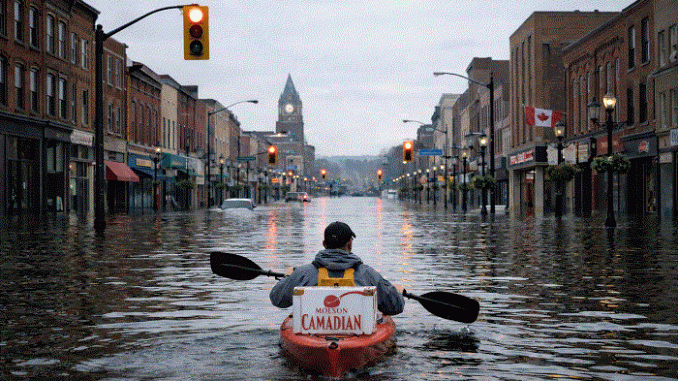
With rain warnings in the forecast, it is a good time to remember that Peterborough has seen what happens when a storm stops being weather and turns into a civic disaster.
The flood of July 15, 2004 remains the city’s defining modern rainfall event. More than 235 millimetres of rain fell in a matter of hours. Much of downtown flooded. Roughly a third of the city was affected. The wastewater system was pushed to five times capacity. It was not just a bad storm. It was the kind of storm that exposes, all at once, the limits of pipes, roads, planning and hope.
That matters because stormwater systems are not built to handle everything. Peterborough’s minor storm sewer system is generally designed for a 1-in-5-year storm. After that, the major system is meant to take over — roads, swales, ditches and overland routes that carry water when the underground network can no longer keep up. Even the city’s current 100-year, 24-hour design rainfall is 108.7 millimetres.
So the 2004 flood was not just a case of drains failing on an ordinary wet day. It was a storm that delivered more than double the rainfall depth the city now uses as its 100-year benchmark. In plain terms, Peterborough was hit by something far beyond what municipalities routinely design for. That does not mean another identical storm is required for serious trouble, but it does mean a major flood here again would likely take another short, high-intensity event strong enough to overwhelm both the sewers below ground and the overland routes meant to act as backup when those sewers reach their limit.
Since then, the city has not stood still. Peterborough identified key drainage problem areas, built a list of more than 100 flood-reduction projects, and kept working through them with studies, inspections, sewer cleaning, repairs, relining and larger infrastructure upgrades. In 2023 alone, it spent $2.5 million on flood-reduction and inflow-and-infiltration work, then set aside another $2.5 million in 2024 to continue it. In 2025, council also advanced a $27.6 million Charlotte Street stormwater project to install a 100-year-capacity sewer through a key stretch of the downtown core. Taken together, that is $32.6 million in recent identified spending and committed work aimed directly at reducing flood risk.
So yes, Peterborough is safer than it was twenty years ago. It knows more about where the system is vulnerable. It has mapped more. It has upgraded more. It has invested real money trying to reduce the odds of another citywide disaster. But safer is not the same as flood-proof. Older parts of the city still reflect older infrastructure thinking, some of the biggest resilience projects are still underway, and the same truth remains: when rainfall becomes extreme enough, water will always find the weak point.
That is the real story. Peterborough’s drainage system was never built to defeat biblical rain. It was built to manage ordinary storms, withstand serious ones, and rely on a larger overflow network when the pipes run out of room. In 2004, all of that was overwhelmed. Two decades later, the city has done real work and spent real money to reduce the risk. But when the forecast starts filling up with showers and warnings, the question still hangs over the city: not whether it can flood here again, but how hard it would have to rain before Peterborough starts holding its breath.