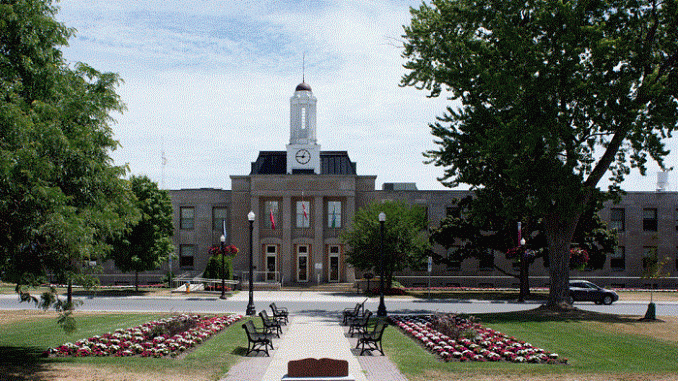
City Hall this week leaned hard into the future — glass, steel, and planning language — while the present sat patiently off to the side, waiting to be invited into the conversation.
The main attraction was height. Again.
Council moved forward on the proposed 17-storey mixed-use tower near Little Lake, a project that would bring up to 225 residential units into a part of the city not long ago defined by modest scale and low horizons. It cleared General Committee, which in municipal terms means it’s past the polite objections phase and heading toward a real decision.
At the same time, the city is also dealing with another high-rise proposal in East City, a neighbourhood where “tall” used to mean two storeys and an attic. Two towers, two parts of town, both arriving at roughly the same moment — which suggests this isn’t coincidence. It’s momentum.
Council’s rationale is familiar. More units mean more supply. More supply helps affordability. Density supports transit, business, and downtown vitality. All true, in theory. But theory has a way of smoothing over the details — like what those units cost, who actually lives in them, and how long it takes before supply translates into relief for people already priced out.
That part didn’t get much airtime.
Instead, the conversation stayed comfortably in the realm of approvals, zoning language, and site-specific details. Height limits, setbacks, land use compatibility — the mechanics of growth, not the consequences.
And growth, to be fair, is happening. Peterborough is no longer debating whether it should build up. It’s debating how quickly.
The speed is what stands out. For years, the city expanded outward in predictable patterns — subdivisions inching across available land, infrastructure following behind. Now, with provincial pressure to intensify and land constraints tightening, the conversation has shifted almost overnight. Towers are no longer hypothetical. They’re applications on the table.
The risk, as always, is that the pace of approvals outruns the pace of planning.
While council was focused on height, it also turned inward to its own process, reviewing updates to the procedural by-law — the rules that determine how debates happen and how quickly they end. These changes are meant to keep meetings efficient, prevent procedural dead-ends, and maintain order inside the chamber.
Efficiency is useful. It keeps meetings from drifting into midnight marathons. But it also has a way of narrowing conversations just when they’re getting interesting.
Outside the chamber, the issues people tend to talk about — homelessness, rising taxes, affordability that feels increasingly theoretical — didn’t take centre stage this week. They were present in the background, as they usually are, but not driving the agenda.
And that’s the quiet divide that defines most council meetings.
Inside: structured debate, controlled timelines, decisions that move projects forward.
Outside: a city dealing with visible homelessness, higher costs, and the everyday friction of growth that doesn’t always feel evenly distributed.
Council also handled routine administrative work, including reviewing ongoing agreements like the city’s nuclear host funding arrangement — $75,000 in 2026 with adjustments through 2030 — the kind of item that rarely draws attention but reflects the broader responsibilities tied to the region.
It’s all part of the same machine.
This week didn’t deliver fireworks. No landmark vote, no dramatic split. What it delivered was something more typical — a steady push toward a different version of Peterborough, one approval at a time.
The skyline inches upward. The rulebook tightens. The conversations stay focused where they’re easiest to manage.
And the bigger questions — who benefits, who pays, and whether the city on paper matches the city on the ground — remain open, waiting for a week when they make the agenda instead of the margins.