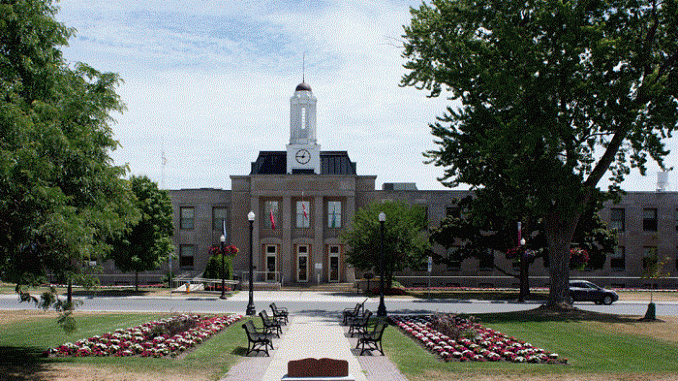

City Hall this week spent a fair bit of time talking about height — specifically how high Peterborough might soon reach into the sky — while a few of the city’s more stubborn problems sat quietly in the background waiting for their turn.
The headline discussion was a proposal for a 17-storey mixed-use tower near Little Lake, a development that could bring up to 225 residential units and ground-floor commercial space to the downtown edge. The project cleared General Committee and now heads toward a final council vote. For Peterborough, a city whose skyline has traditionally been measured in church steeples and grain elevators, seventeen storeys is not a small step. It’s a declaration that density is no longer theoretical.
And that tower is not alone. Council is also dealing with another proposed high-rise in East City, a project that has raised eyebrows in a neighbourhood not exactly known for vertical ambition. Two towers entering the planning pipeline at roughly the same time raises an obvious question: why the sudden enthusiasm for building upward?
The official answer is predictable. Density supports transit. Density supports housing supply. Density supports downtown vitality. Planners have been repeating those lines for years, and none of them are wrong. But they don’t fully explain the sudden urgency.
Peterborough has spent decades growing outward — subdivisions spreading north, west, and south — while downtown buildings remained modest. Now, almost overnight, the conversation has shifted from “should we build higher?” to “how high is too high?” It’s a reasonable debate, but the speed of the shift suggests something else at work: pressure.
Housing demand is real. Land is expensive. Provincial policy increasingly pushes cities toward intensification. And developers have discovered what planners have known for years — the only direction left in many parts of Peterborough is up.
So the towers advance.
Meanwhile, council also spent time rewriting its own procedural by-law, the rulebook governing how meetings operate. These changes shape how motions are introduced, how debates unfold, and how easily councillors can bring discussions to a close. It’s housekeeping work, the municipal equivalent of reorganizing the filing cabinet.
What the rulebook revision does not address, of course, are the problems residents are talking about outside council chambers.
Homelessness remains visible and unresolved across parts of the city. Encampments and shelter capacity continue to generate debate among residents and service agencies. Housing affordability — the issue most often cited as justification for taller buildings — remains stubbornly out of reach for many renters.
Then there’s the tax conversation. The city entered 2026 after adopting a budget that originally pointed toward an all-inclusive increase above seven percent before council reduced it by drawing $3 million from the Legacy Income Retention Reserve and deferring projects. It lowered the number, but it didn’t eliminate the pressure. Property taxes are still climbing in a year when many households are already feeling stretched.
None of that dominated the agenda this week.
Instead, council reviewed a funding agreement with Ontario Power Generation that provides $75,000 in 2026, with inflation adjustments through 2030, to support emergency planning responsibilities tied to nearby nuclear facilities. It’s responsible governance, but it also illustrates the rhythm of municipal life: even when major social questions loom, the machinery of local government keeps moving through reports, agreements, and planning approvals.
Put together, the week tells a familiar story about Peterborough’s priorities. Council is clearly willing to debate how tall buildings should be, how zoning rules should evolve, and how procedural rules should guide their meetings.
The harder conversations — homelessness, affordability beyond new condos, the long-term pressure of rising municipal taxes — remain somewhere further down the agenda.
Cities don’t change in dramatic moments. They change through the steady accumulation of decisions. A zoning amendment here, a tower approval there, a budget trimmed with reserve funds, a procedural rule rewritten.
And gradually the skyline rises, the tax bill shifts, and residents look around and wonder when exactly the city decided to grow upward so quickly — and whether the problems on the ground were keeping pace.